

Talent acquisition specialists are continuously challenged to match candidates with the right skills to positions that feed evolving business needs. Technology and data are the one-two punch that empowers HRs to do so effectively.
Skills Architecture: Building the SBO Foundation
A comprehensive skills architecture helps HR leaders start the process with a clear understanding of what skills are already within their talent pool and where the skills gaps lie so they can target the right candidates more quickly.
As such, skills architecture acts as the blueprint that defines and structures the skills within an organization, unifying skills language and moving beyond traditional job descriptions to establish an agreed-upon nomenclature. It’s the foundation on which a centralized Skills-Based Organization is built, pulling together skills data across teams to form a larger, more strategically malleable view.
“We’ve always historically said that this system doesn’t talk to this system, and this system doesn’t talk to this system, and the spaghetti plate of systems is what disables us from getting data or from making informed decisions that are embedded and rooted in true data and analytics,” says Sadia Ayaz, VP of Talent Management for Veolia. “Here we are today, capable of doing that. AI can take all of that unstructured data and make sense of it.”
AI: The SBO Tech Enabler
AI’s machine learning algorithms and expedited data analytics are the technological backbone of a sophisticated skills architecture. This is due to its ability to:
- Ingest vast datasets to identify both existing and emerging skills within an organization
- Detect patterns and trends, allowing HRs to stay ahead of critical skill gaps or areas that require upskilling
- Reveal hidden talent within an existing workforce, uncovering internal job candidates for consideration
Beyond talent acquisition, AI-driven technologies also fortify talent management strategies in a Skills Based Organization. Through personalized learning paths and recommendations, AI enables employees to acquire new skills in alignment with organizational goals, while also benefiting from individualized professional development.
By harnessing the power of AI to construct a detailed and dynamic skills architecture, and engaging AI as the tech enabler for a successful Skills-Based Organization, HRs can hire and retain the right talent to fuel an SBO workforce model. Synergy between skills architecture and AI is the cornerstone of shaping the future of talent acquisition and organizational success.
Learn more about the power of retrain.ai’s Talent Intelligence platform here.



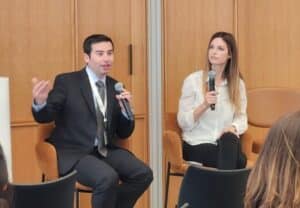 Starting off the day, keynote speaker Commissioner Keith Sonderling of the EEOC shared insights on the expansion of Responsible AI governance across the U.S., emphasizing that current regulations put the onus on businesses using AI systems to ensure they generate fair end results–
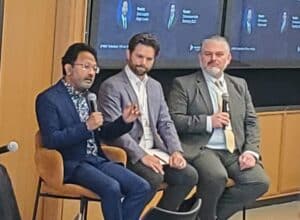 Talk of Responsible AI continued into the first panel
 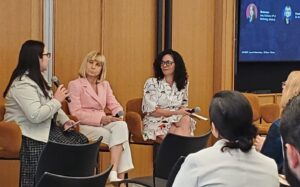 In conversation with retrain.ai’s Amy DeCicco, Dr. Anna Tavis of the Human Capital Management Department at New York University and Dr. Yustina Saleh from The Burning Glass Institute posed provocative questions, encouraging attendees to think about questions like whether empathy is truly a skill or a trait, or how HR leaders can tell from a skills profile whether or not a candidate will be able to do the job needed.
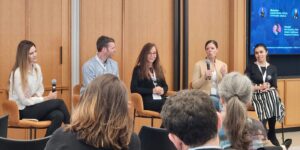 With more enterprises talking about transforming to an SBO model, Dr. Sandra Loughlin of EPAM Systems shared lessons learned from her company’s transformation, while Heidi Ramirez-Perloff discussed The Estee Lauder Company’s exploration into SBO strategy. Urmi Majithia of Atlassian delved into executing technology to help overcome the challenges of becoming an SBO, and Ben Eubanks of Lighthouse Research &
 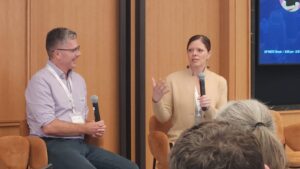 Following the panel discussion, Dr. Loughlin sat down for a one-on-one with retrain.ai CEO Dr. Shay David to go more in depth into EPAM’s experience developing a thriving SBO strategy, sharing benefits, pitfalls and lessons learned along the way.
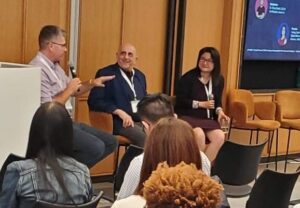 No discussion around Responsible HR would be complete without an exploration of the huge impact ChatGPT and other